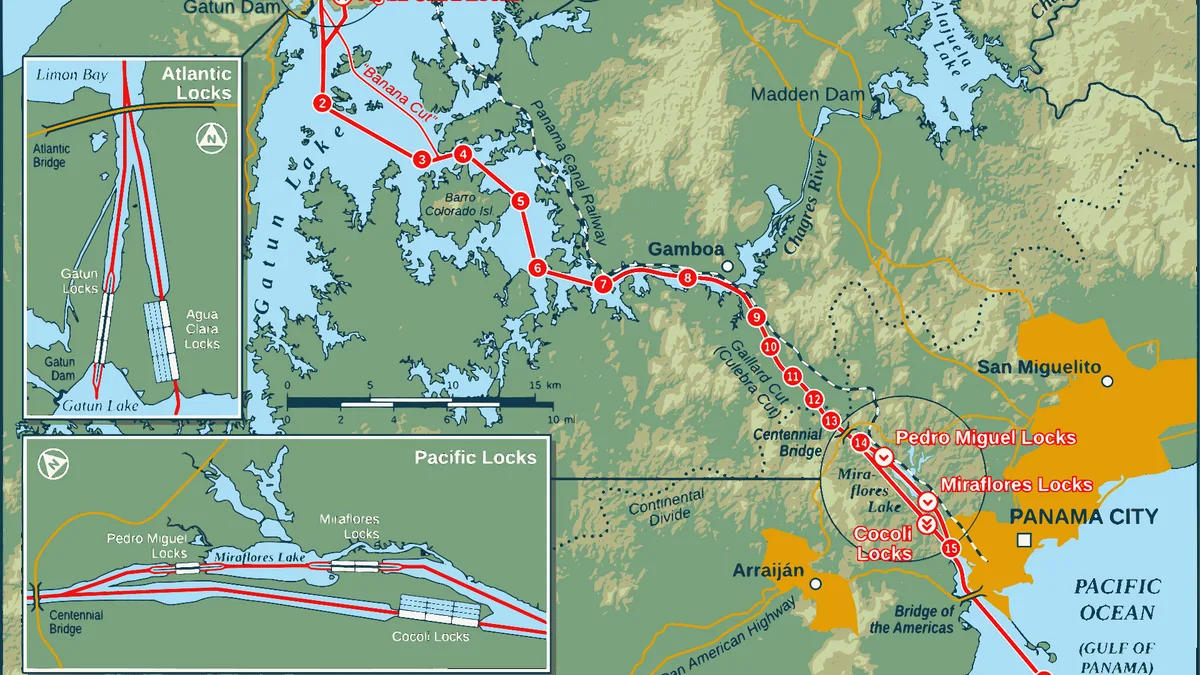
Panama Canal
| Primary trade lane | East Coast of the Americas to Asia |
|---|---|
| Original use | Shortcut for maritime trade between Atlantic and Pacific |
| First opened | 1914 |
| Operated by | Panama Canal Authority |
| Typical transit time | 8-10 hours |
| Lock system | Three sets of locks (Panamax and Neopanamax) |
| Maximum vessel dimensions (Neopanamax) | Approximately 1,200 feet long, 160 feet beam |
Origin and history
The Panama Canal is an artificial waterway located in the Central American country of Panama. Its construction was a monumental engineering project initiated by the United States in the early 20th century, following earlier failed French efforts in the late 19th century. The United States led the project after securing a treaty with Panama, which had just become independent from Colombia in 1903. The canal's construction involved overcoming immense challenges, including tropical disease and difficult terrain, and it officially opened for maritime traffic in 1914. Control and operation of the canal were held by the United States for most of the 20th century under a treaty arrangement. Full administrative control was peacefully transferred to the Republic of Panama on December 31, 1999, and it is now managed by the Panama Canal Authority, a Panamanian government agency.
What it is for
The primary function of the Panama Canal is to provide a shortcut for maritime vessels traveling between the Atlantic and Pacific Oceans. It eliminates the need for ships to navigate the lengthy and hazardous route around the southern tip of South America, specifically Cape Horn. This transit saves a substantial amount of time, fuel, and distance for global shipping, making it a critical conduit for international trade. The canal accommodates a wide range of vessels, including container ships, bulk carriers, tankers, and passenger ships, though their size is constrained by the canal's lock dimensions. Its operation directly influences routing decisions for cargo moving between Asia and the East Coast of the Americas, as well as for trade between the west coast of South America and the U.S. East Coast and Europe. The canal's locks lift ships from sea level up to an artificial lake, Gatun Lake, and then down to the opposite ocean, a process that defines its unique operational characteristics.
Pros and cons
A primary advantage of the Panama Canal is the significant reduction in voyage time and distance, which translates directly into lower fuel costs and faster delivery times for shippers. It provides a vital and reliable link for specific trade lanes, particularly between Asia and the U.S. East and Gulf Coasts, offering a competitive alternative to all-water routes via the Suez Canal or land bridges across North America. However, its capacity is physically limited by the size of its locks, historically excluding the world's largest container ships (known as Ultra Large Container Vessels) until the 2016 expansion, and transit slots remain a finite resource. Operational constraints are a major con; during periods of drought, the canal authority must restrict the number of daily transits and impose draft limitations, causing significant delays and forcing carriers to offload cargo or seek costly alternative routes. Shippers and carriers often regret reliance on the canal during such periods of water scarcity, as the resulting auction for transit slots can drastically increase the total cost of shipment beyond initial forecasts. A common mistake is for logistics planners to assume consistent transit times and costs, failing to account for the canal's vulnerability to climate variability and its associated surcharges and booking systems.
Who it suits
The Panama Canal suits shipping lines operating vessels within the size limits of the canal's locks, particularly those on the key East Asia to U.S. East Coast trade lane where the time savings are most pronounced. It is well-suited for cargo where a balance between speed and cost is required, being faster than all-water routes around Africa but generally less expensive than air freight or multimodal rail options across the United States. Commodity shippers moving time-sensitive manufactured goods, such as consumer electronics or apparel, often find the canal's service optimal for inventory management. The route also suits specific bulk cargoes, like grains from the U.S. Gulf to Asia or liquefied natural gas (LNG) exports, for which the canal provides a direct pathway. Conversely, it is less suited for shipments originating or destined for the U.S. West Coast, for which direct transpacific shipping is more efficient, or for the largest vessel classes that still exceed the post-Panamax dimensions. Ultimately, it suits traders and carriers who can absorb or manage the volatility in transit costs and scheduling that arises from the canal's operational and environmental constraints.
Latest Panama Canal news
Latest reporting
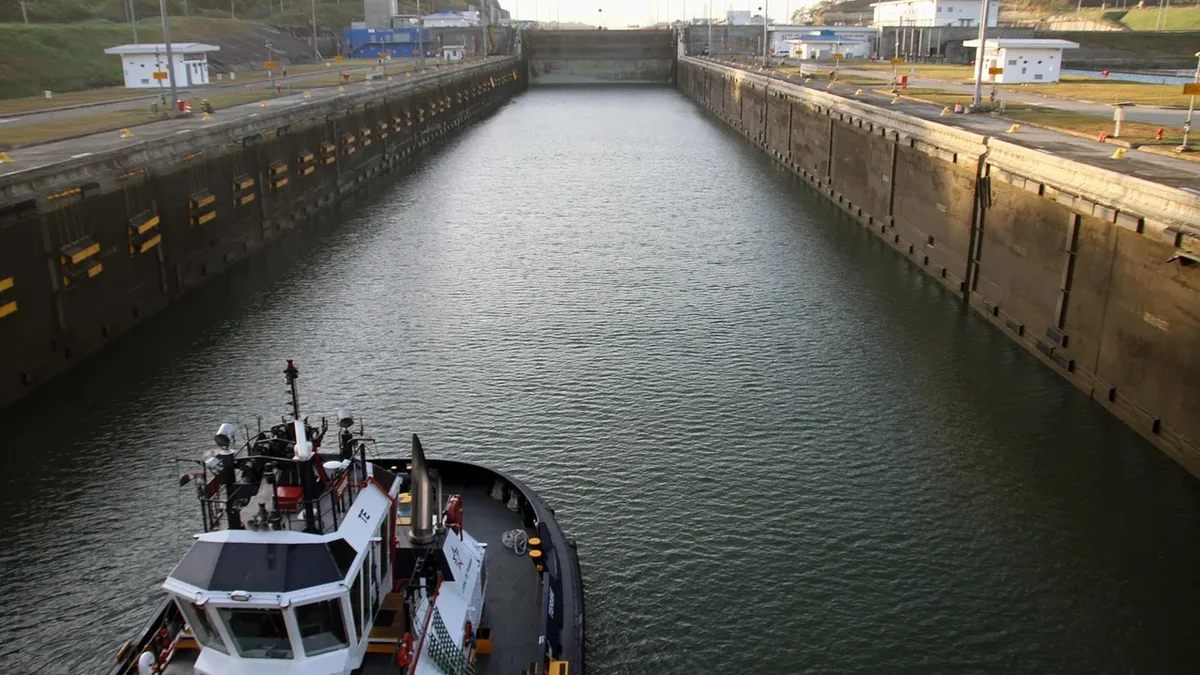
Panama Canal Expands Neopanamax Capacity to 10 Daily
The Panama Canal Authority has increased the Neopanamax vessel draft limit to 49 feet and will add a daily transit slot starting October 15, 2026...
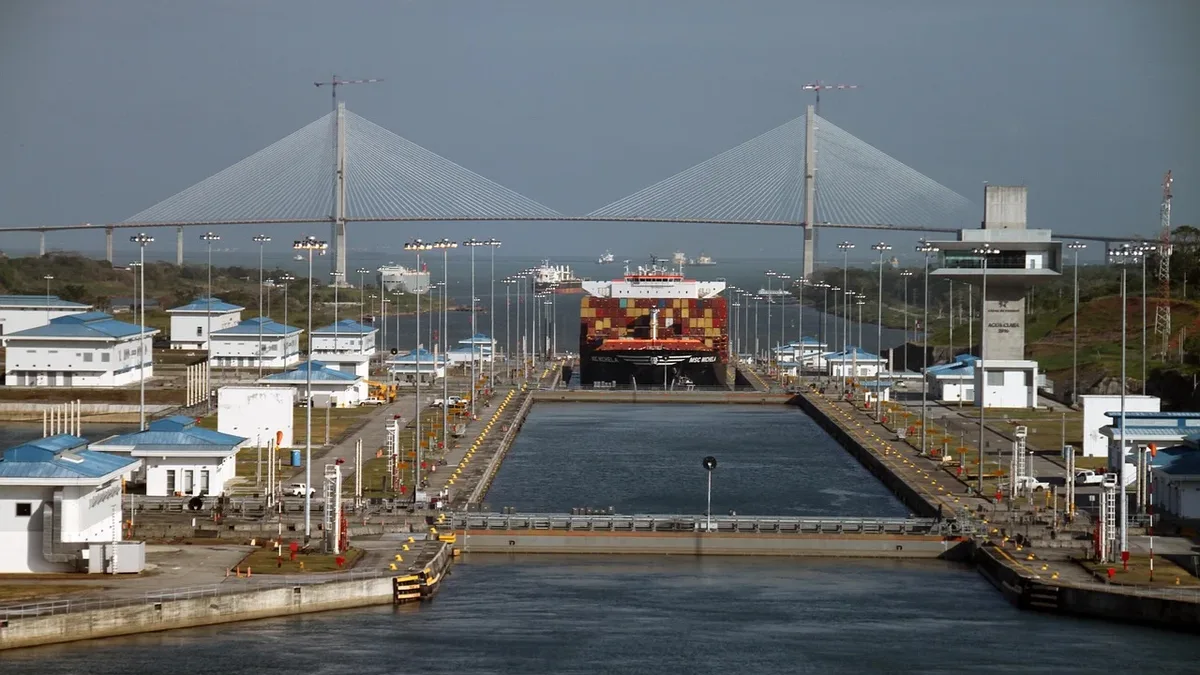
Panama Canal passage hits record $5.3m
Record Panama Canal auction fees and Amazon route surcharges show rising transit costs from drought and conflict, as port congestion reaches new...
Panama Canal
Daily capacity cut to 32 ships due to water shortages