Flexport Launches AI Agent Server for Freight Booking
Flexport launched a Model Context Protocol server enabling AI agents to book freight, expanding its automation suite with new customs tools, multimodal
Flexport announced its Model Context Protocol (MCP) Server on Tuesday, allowing shippers' AI agents to track, quote, and book freight on its platform using plain language. Businesses can connect Flexport to agents like Claude, ChatGPT, Microsoft Copilot, Muse, or their own internal systems to manage shipments without logging into the platform directly. An agent can submit cargo details, book against a company's negotiated rate, and instantly receive a booking ID and transit time. This server leads a broader technology release aimed at embedding AI directly into logistics workflows.
Every request through the MCP server lands on Flexport's own fleet of purpose-built AI agents, which already process 21 million tasks annually. A dedicated quoting agent converts rate requests into custom quotes whether they arrive by email, via MCP, or inside the Flexport Platform. Each agent operates with guardrails set through a custom evaluation platform built for governance and traceability. Every exception is routed to a human expert, and every action is traceable. This infinitely scalable AI workforce allows Flexport to scale its white-glove customer service.
Enhanced customs and classification tools in Flexport Atlas
The update extends Flexport Atlas with multimodal routing, AI-curated disruption monitoring, per-container emissions estimates, and new customs capabilities. The Customs Technology Suite, already live for U.S. entries, audits entries against hundreds of rules before they reach government agencies. Companies can now build bespoke audit rules around their own procedures, which are checked against every entry in real time and flagged to operations staff before filing.
A new classification tool turns the assignment of 10-digit Harmonized Tariff Schedule codes into a guided conversation. The tool surfaces a recommended, defensible code in seconds, showing linked U.S. Customs and Border Protection rulings and its reasoning in real time. Users can also submit their HTS code to be validated by one of Flexport’s licensed customs brokers before filing. The Netherlands and the U.K. are next for the Customs Technology Suite rollout.
Multimodal routing adds air, rail, and barge alongside ocean freight, allowing users to compare every shipping option between any two places. Atlas also gained an AI-curated disruption layer that automatically monitors news sources for events that could affect shipments. Per-container emissions estimates are now provided on every ocean route to simplify finding lower-carbon options.
Flexport scales AI workforce and global operations
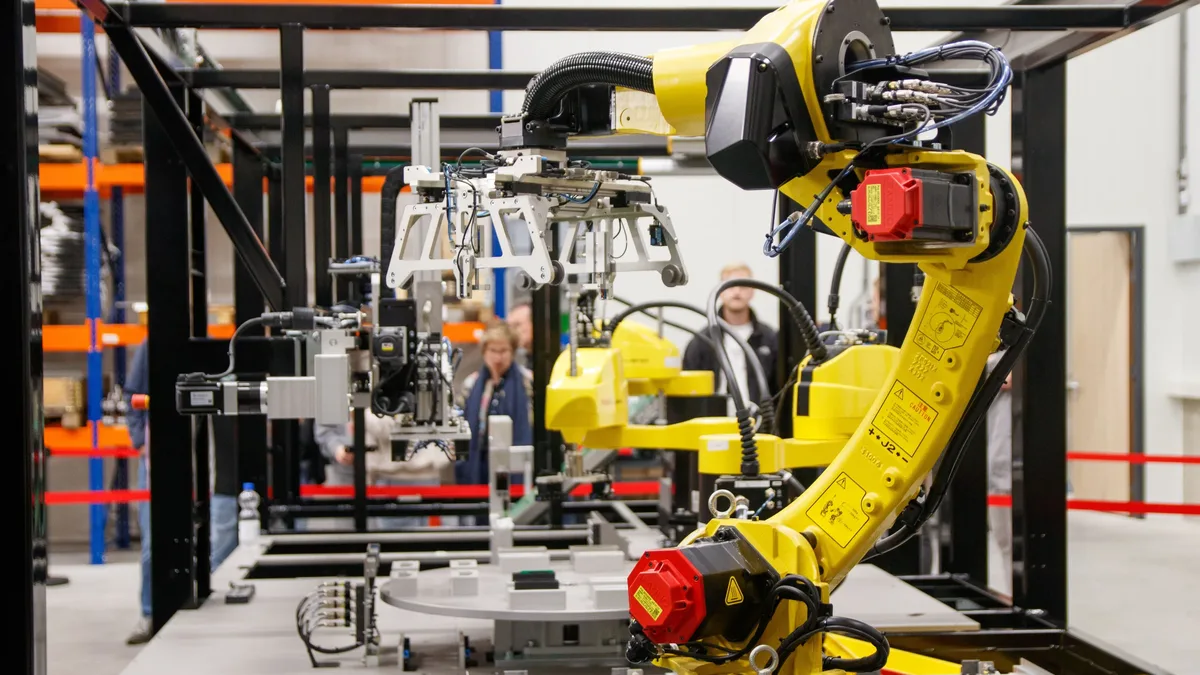
Flexport is a San Francisco-based forwarder used by more than 13,000 companies. Over the past year, it opened offices in eight new countries: Japan, France, Belgium, Cambodia, Brazil, the Philippines, Australia, and Indonesia. The company recently opened its first fully automated e-commerce fulfillment center outside Chicago, where more than 350 robots bring inventory to workers. The site runs at double the efficiency of a traditional warehouse.
This opening follows Flexport’s launch of fulfillment services in Mississauga, Ontario, and Manchester, England earlier this month. The broader technology release, including the MCP server and Atlas upgrades, is supported by this expanded global operational footprint.
Vision for autonomous supply chains
Founder and CEO Ryan Petersen framed the release as a step toward autonomous logistics. He said the future of global logistics is intelligent supply chains that see problems before they happen, calculate the fix, and execute it in a recurring self-improvement loop. The new tools are designed to move in that direction, where AI agents detect issues and execute improvements. The Netherlands and the U.K. are next for the Customs Technology Suite rollout.