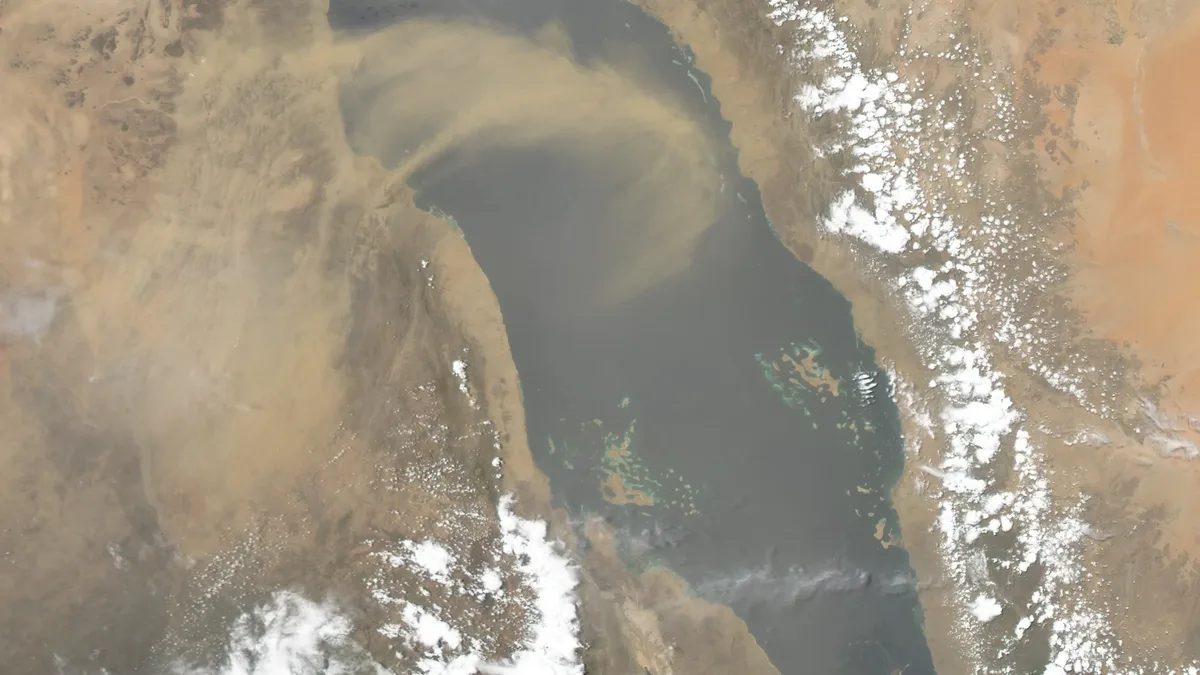
Bab El Mandeb
| Location | Between Yemen (Arabian Peninsula) and Djibouti, Eritrea (Horn of Africa) |
|---|---|
| Connects | Red Sea to Gulf of Aden and Indian Ocean |
| Primary traffic type | Container ships, oil tankers |
| Strategic significance | Critical for Europe-Asia trade and Persian Gulf oil exports |
| Width at narrowest point | Approximately 20 miles (32 kilometers) |
| Key ports on route | Djibouti (Djibouti), Aden (Yemen), Jeddah (Saudi Arabia) |
| Alternative route | Cape of Good Hope (significantly longer transit) |
Origin and history
The Bab El Mandeb is a natural strait located between the continents of Africa and Asia. Its name is derived from Arabic, meaning "Gate of Lamentation" or "Gate of Tears," a reference to the perilous navigation historically associated with the passage. The strait was formed by geological processes millions of years ago as part of the Great Rift Valley system. It has served as a crucial maritime passage since the earliest periods of long-distance trade and exploration. The surrounding region, encompassing the coasts of Djibouti, Eritrea, and Yemen, has been inhabited for millennia and controlled by successive regional powers. Its modern strategic significance became globally cemented with the opening of the Suez Canal in the late 19th century, integrating it into the primary Europe-Asia shipping lane.
What it is for
Bab El Mandeb functions as a critical maritime chokepoint for global seaborne trade, connecting the Red Sea to the Gulf of Aden and the wider Indian Ocean. Its primary purpose is to facilitate the transit of vessels, most notably container ships, tankers, and bulk carriers, between the Mediterranean and Asia. The strait is an indispensable segment of the route from the Suez Canal to major ports in South Asia, Southeast Asia, and the Far East. It is particularly vital for the transit of petroleum and liquefied natural gas (LNG) from the Persian Gulf to European markets. The narrow width of the channel necessitates strict traffic separation schemes managed by regional authorities to prevent collisions. The continuous flow of commercial shipping through this waterway underpins its role as essential global infrastructure, with no viable alternative for large vessels.
Pros and cons
The primary advantage of the Bab El Mandeb route is its irreplaceable role in minimizing transit time and fuel consumption for voyages between Europe and Asia, offering substantial economic savings compared to the Cape of Good Hope alternative. Its established shipping lanes and proximity to key bunkering ports, like Djibouti, provide logistical support for vessels. A significant con is its acute vulnerability to regional geopolitical instability and security incidents, which can disrupt traffic almost instantaneously. Piracy, though reduced from its peak in the early 21st century, remains a latent threat, while missile and drone attacks from conflict zones on its shores have occurred in recent decades. Shipping lines and charterers who underestimate the volatility of the region often regret their assumption of continuous safe passage, facing sudden spikes in war risk insurance premiums and costly rerouting decisions. The common mistake is viewing the strait purely as a geographic feature rather than a dynamic political and security environment that can impose severe operational and financial costs without warning.
Who it suits
This route suits large-scale container carriers, oil tankers, and LNG carriers for which the time savings justify the inherent risk and associated costs, such as additional insurance and security measures. It is essential for just-in-time supply chains and time-sensitive cargo moving between European consumer markets and Asian manufacturing hubs. Major global shipping lines and integrated logistics operators, who can absorb or mitigate the financial impacts of sudden disruptions, are its primary commercial users. The route does not suit operators of low-value bulk commodities or those with extremely flexible schedules who can more easily absorb the longer transit time around the Cape of Good Hope. It is also poorly suited for owners or charterers without robust risk management departments capable of monitoring the complex and fluid security situation in real time. Ultimately, the Bab El Mandeb suits those for whom the economic calculus of speed outweighs the potential for severe, unpredictable disruption.