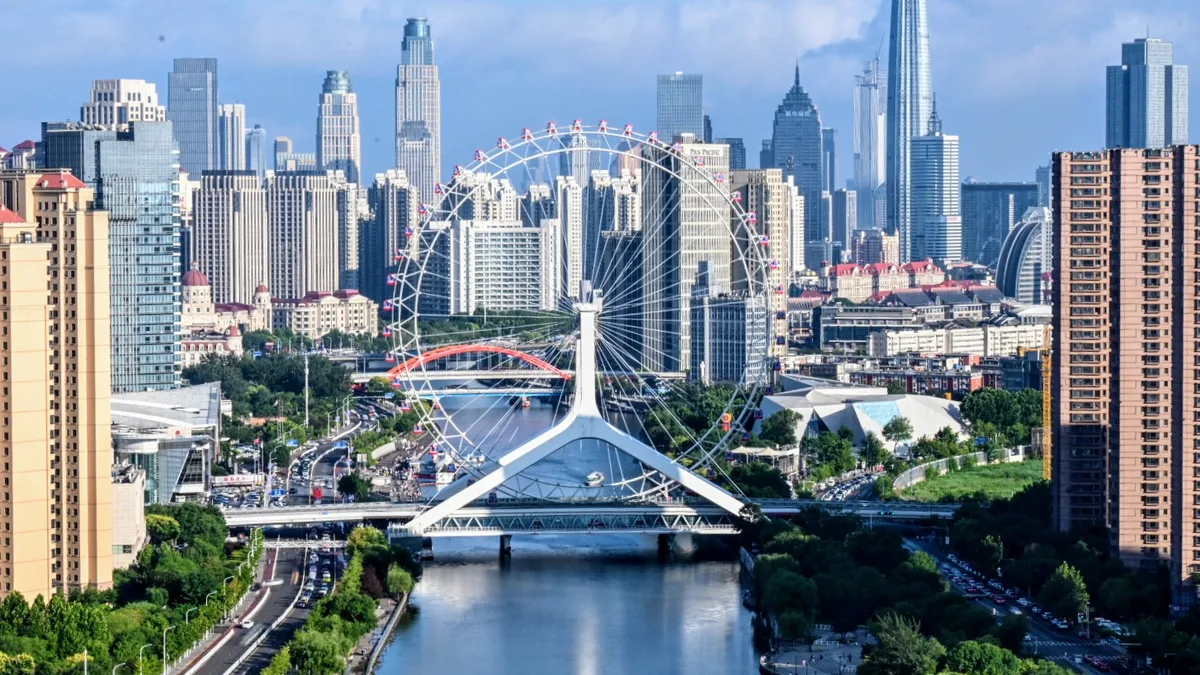
Tianjin
| Port of origin | Tianjin, China |
|---|---|
| Port of destination | Rotterdam, Netherlands |
| Typical transit time | 30 to 40 days |
| Primary shipping route | Via Suez Canal |
| Common container sizes | 20-foot (TEU), 40-foot (FEU) |
| Major shipping alliances serving route | THE Alliance, Ocean Alliance |
| Key carrier terminals | Tianjin Xingang, Rotterdam Maasvlakte |
| Documentary requirements | Bill of lading, commercial invoice, packing list |
Origin and history
Tianjin is a major port city and provincial-level municipality in northeastern China. Its origins as a significant settlement date back centuries, with its development as a port beginning in earnest during the Yuan dynasty in the 13th century. The city's modern port infrastructure and its role in international trade expanded dramatically following the Second Opium War in the mid-19th century, when it was opened to foreign trade by the Treaty of Tientsin. Throughout the 20th century, Tianjin Port grew into a critical industrial and logistics hub for northern China. The port's facilities have been continuously modernized and expanded, particularly in recent decades, to handle the massive containerized trade volumes of the 21st century. Its historical development is inextricably linked to its strategic location at the confluence of the Haihe River and the Bohai Sea.
What it is for
Tianjin Port serves as the primary maritime gateway for the Beijing-Tianjin-Hebei economic region and a vast portion of northern China's industrial hinterland. It functions as a critical node for importing raw materials, such as iron ore and coal, and for exporting manufactured goods produced in its surrounding industrial zones. The port complex handles a wide array of cargo types, including containers, dry bulk, liquid bulk, and roll-on/roll-off vehicles. It provides essential connectivity to global shipping lanes, with regular liner services to major ports across Asia, Europe, and the Americas. The port also integrates with extensive inland transportation networks, including railways and highways, to facilitate the movement of goods to and from the interior. Its function extends beyond pure cargo handling to include value-added logistics services, warehousing, and free trade zone operations.
Tianjin tracking
Tracking shipments through Tianjin Port typically utilizes container numbers or booking references provided by the shipping line or freight forwarder. Most major ocean carriers and integrated logistics providers offer online tracking portals where customers can view real-time status updates. These updates include gate-in times at the terminal, vessel loading confirmation, departure and arrival estimates, and final container gate-out. For cargo moving via rail from the interior to the port, railway consignment note numbers may provide additional tracking visibility for the inland leg. Port community systems and some third-party logistics platforms may also aggregate tracking data from multiple sources for a consolidated view.
Tianjin customer care
Customer care for port-related services is not centralized under a single "Tianjin" entity but is provided by the individual operating companies. Each shipping line, freight forwarder, trucking company, and terminal operator maintains its own customer service channels. General port administration inquiries may be directed to the Tianjin Port Group, but specific cargo issues must be resolved with the relevant service provider. Common customer care issues include documentation errors, booking amendments, detention and demurrage charges, and damage claims. Resolution often requires navigating between multiple parties, such as the carrier, terminal, and customs broker. Effective communication typically requires providing precise container numbers, booking references, and commercial documentation to the correct department.
Tianjin branch locator
As a physical port complex, Tianjin does not have "branches" in a commercial sense; its operations are spread across distinct port areas and terminals. The main port areas are located in Tanggu, Dongjiang, and Beijiang, along the Bohai Sea coast. Major container terminals include the Tianjin Port Container Terminal and the alliances operating within the Dongjiang Port Area. Shipping lines and global freight forwarders maintain their own commercial offices, often clustered in the Tianjin downtown area or the port-side logistics parks. These company offices are the points of contact for sales, documentation, and customer service. Logistics service providers, customs brokers, and trucking firms also have their operational bases in the port's surrounding industrial zones. Finding a specific service provider requires identifying the company name and locating its registered office or operational yard address within the Tianjin municipality.
Tianjin rates
Rates for moving a container through Tianjin Port are not published by a single authority and are highly variable. Total costs are an aggregate of multiple separate charges levied by different entities along the supply chain. The ocean freight rate, set by shipping lines or alliances, covers the vessel transport from Tianjin to the destination port and is subject to market volatility, fuel costs, and demand. Terminal handling charges are applied by the port operator for loading and unloading containers to and from the vessel. Inland transportation costs cover trucking or rail movement to/from the port gates. Additional prevalent charges include documentation fees, customs clearance fees, and potential fuel surcharges. Detention and demurrage fees are incurred if containers are not returned or cargo is not collected within the allotted free time. The final cost is therefore a composite figure unique to each shipment's routing, carrier, commodity, and time of booking.
Pros and cons
A primary advantage of using Tianjin Port is its direct service to a massive industrial and consumer hinterland, reducing inland haulage costs for northern Chinese shippers. The port offers extensive global connectivity with frequent sailings to most world regions, providing scheduling flexibility. Its modern infrastructure, including deep-water berths, allows it to efficiently handle ultra-large container vessels. A significant con is its susceptibility to congestion, particularly during peak shipping seasons or due to adverse weather, which can lead to vessel delays and schedule reliability issues. Winter operations can be impacted by ice in the Bohai Sea, sometimes requiring icebreaker assistance. The complexity of dealing with numerous service providers and regulatory bodies can create administrative burdens and opacity in cost structures. Shippers sometimes regret routing through Tianjin when seeking faster transit times to southern Chinese destinations, for which southern ports are often more direct.
Who it suits
Tianjin Port is best suited for manufacturers and exporters located in northern China, including Beijing, Hebei, Shanxi, and Inner Mongolia, for whom it is the closest major port. It is a logical choice for cargoes with final destinations in Northeast Asia, as it serves as a key transshipment hub for ports in Korea and Japan. Bulk commodity importers, such as steel mills requiring iron ore and coal, are heavily reliant on Tianjin's specialized dry bulk terminals. The port suits shipments where cost-optimization for the inland leg is a higher priority than achieving the absolute shortest ocean transit time to distant markets. It is less suited for cargo originating in southern or central China, where routing through Shanghai or Shenzhen would typically result in shorter total supply chain durations. Shippers with time-sensitive cargo to North America or Europe may sometimes prefer southern Chinese ports that offer more direct and potentially faster liner services.