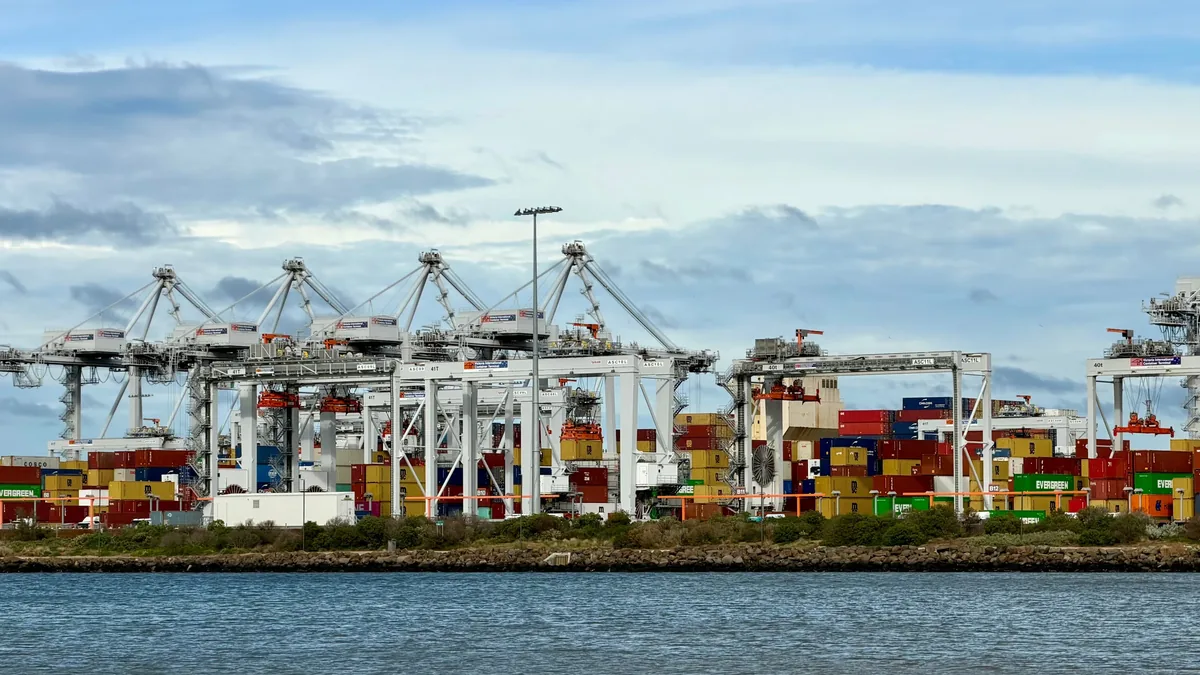
Tanjung Pelepas
| Port name | Port of Tanjung Pelepas |
|---|---|
| Country | Malaysia |
| Operational status | Operational |
| Primary function | Container transshipment hub |
| Major trade lane | Asia-Europe |
| Ownership | Majority state-owned |
| Container terminal capacity | Very high capacity |
Origin and history
Tanjung Pelepas is a major container port located in southwestern Johor, Malaysia. Its development began in the late 1990s as a greenfield project to create a new deep-water maritime hub. The port was officially opened for commercial operations in the year 2000, marking a significant entry into the competitive Southeast Asian transshipment market. It was established with the strategic intent to leverage its proximity to the Strait of Malacca, one of the world's busiest shipping lanes. The port's creation was a direct initiative by the Malaysian government to enhance the nation's logistics infrastructure and attract major global shipping alliances. Initial growth was propelled by securing a key partnership with the ocean carrier Maersk, which shifted a substantial portion of its regional hub operations from Singapore.
What it is for
Tanjung Pelepas primarily functions as a mega transshipment hub, where large container vessels from mainline intercontinental services exchange cargo with smaller feeder vessels serving regional ports. Its core purpose is to facilitate the consolidation and redistribution of containerized goods within the Asia-Pacific region and between global trade lanes. The port serves as a critical nodal point in supply chains, connecting manufacturing centers in East Asia to consumer markets in Europe, the Middle East, and beyond. It provides extensive container handling services, including loading, unloading, and temporary storage, within a Free Zone area that allows for duty-free cargo manipulation. Furthermore, the port complex integrates directly with rail and road networks for hinterland connections into Peninsular Malaysia and southern Thailand. Its design and operations are optimized for the efficient turnaround of ultra-large container vessels, minimizing vessel waiting time and maximizing schedule reliability for shipping lines.
Tanjung Pelepas tracking
Cargo moving through the Port of Tanjung Pelepas is tracked via the container number or booking reference through the port's own online portal or the systems of the individual shipping line or logistics provider handling the shipment. The port authority provides a visibility platform that displays the status of a container within the terminal, such as its location in the stack, gate-in and gate-out times, and vessel loading details. This tracking data is essential for shippers and freight forwarders to monitor transit progress and plan subsequent inland transportation. The system integrates with Malaysian customs documentation, allowing for the tracking of clearance status for cargo moving in and out of the Free Zone. Accuracy and update frequency can vary depending on the stage of the journey and the level of system integration between the different involved parties.
Tanjung Pelepas customer care
Customer care for port users is managed through dedicated service departments for shipping lines, terminal operators, and landside transport operators. Inquiries typically must be directed to the specific entity responsible for the particular segment of the service, such as the ocean carrier for billing and booking, the terminal operator for container location, or a freight forwarder for end-to-end coordination. The port authority itself handles issues related to port dues, regulations, and access permissions for companies operating within the port zone. Support is provided during standard business hours via telephone, email, and online ticketing systems, with emergency contact points available for vessel-related incidents. Larger shipping lines and logistics firms that are anchor tenants often have assigned account managers and operational teams stationed at the port for direct liaison. The complexity of the logistics chain means that resolving a single issue may require communication across multiple independent service providers, which can sometimes slow down the response time for the ultimate cargo owner.
Tanjung Pelepas branch locator
As a physical port facility, Tanjung Pelepas does not have "branches" in the traditional retail sense. Its operations are centralized at its single, extensive location at the southern tip of the Johor Bahru district in Malaysia. The port's reach and services are extended through a network of partner organizations, including shipping line agencies, freight forwarding offices, and trucking companies located throughout Malaysia and the region. These partner offices, which may be found in major industrial and commercial centers like Kuala Lumpur, Penang, and Shah Alam, act as customer-facing points for arranging cargo movement to and from the port. Furthermore, the port's influence as a transshipment hub means its logistical connectivity effectively spans all ports within Southeast Asia that are served by feeder vessels calling at Tanjung Pelepas. For precise physical access, the port's main administration and gate complex is located at Jalan Pelabuhan, Tanjung Pelepas, with specific terminals within the port assigned to different operating consortiums or shipping lines.
Tanjung Pelepas rates
Rates for moving a container through Tanjung Pelepas are not published as a single tariff but are an aggregate of multiple charges from different service providers. The total cost is primarily composed of the ocean freight rate set by the shipping line, which covers the sea transport from port of origin to port of destination. On top of this, the port terminal operator charges various fees, including a Terminal Handling Charge for the physical movement and stacking of the container within the port. Additional mandatory costs typically include a Bunker Adjustment Factor for fuel, a Currency Adjustment Factor, and potentially a Peak Season Surcharge, all levied by the shipping line. Landside costs such as trucking from a factory to the port, customs brokerage fees, and documentation charges also contribute significantly to the total. These rates are highly dynamic, fluctuating based on market demand, vessel capacity, global fuel prices, and specific trade lane agreements, making it impossible to state a stable figure without a current quotation from a freight forwarder.
Pros and cons
A primary advantage of Tanjung Pelepas is its modern infrastructure designed for the latest generation of container ships, leading to efficient vessel turnaround and reduced port stay times. Its status as a Free Zone allows for cost-effective cargo consolidation and value-added activities without immediate customs duties. The port's strategic location on the Strait of Malacca offers shipping lines geographic flexibility and an alternative to more congested regional hubs. A significant con is its relative dependence on transshipment traffic, which can make cargo ultimately destined for or originating in Malaysia subject to an additional leg of feeder shipping, potentially increasing risk and transit time. Some users report that landside connectivity, while improved, can still experience bottlenecks during peak periods, affecting trucking schedules. A common mistake is for shippers to focus solely on the ocean freight rate without fully accounting for the aggregated terminal and landside costs, which can erode the perceived savings, especially for smaller shipment volumes.
Who it suits
Tanjung Pelepas is particularly suited to large global shipping alliances and vessel operators seeking a high-capacity, cost-competitive transshipment hub in Southeast Asia with deep-water access. It suits manufacturers and exporters whose supply chains are built around mega-vessel services and for whom schedule reliability and port efficiency are critical, even if their cargo is not directly destined for Malaysia. The port is a strong fit for high-volume commodity shippers who can leverage the economies of scale offered by the largest container ships and who benefit from the Free Zone for regional distribution. It is less suited to shippers with time-sensitive cargo moving directly to or from final destinations in Malaysia, as the port's hinterland connections may not be as swift as a dedicated import/export gateway. Furthermore, smaller shippers or those with irregular volumes may find they have less negotiating power on rates and less priority during space-constrained periods compared to the port's anchor carrier clients.