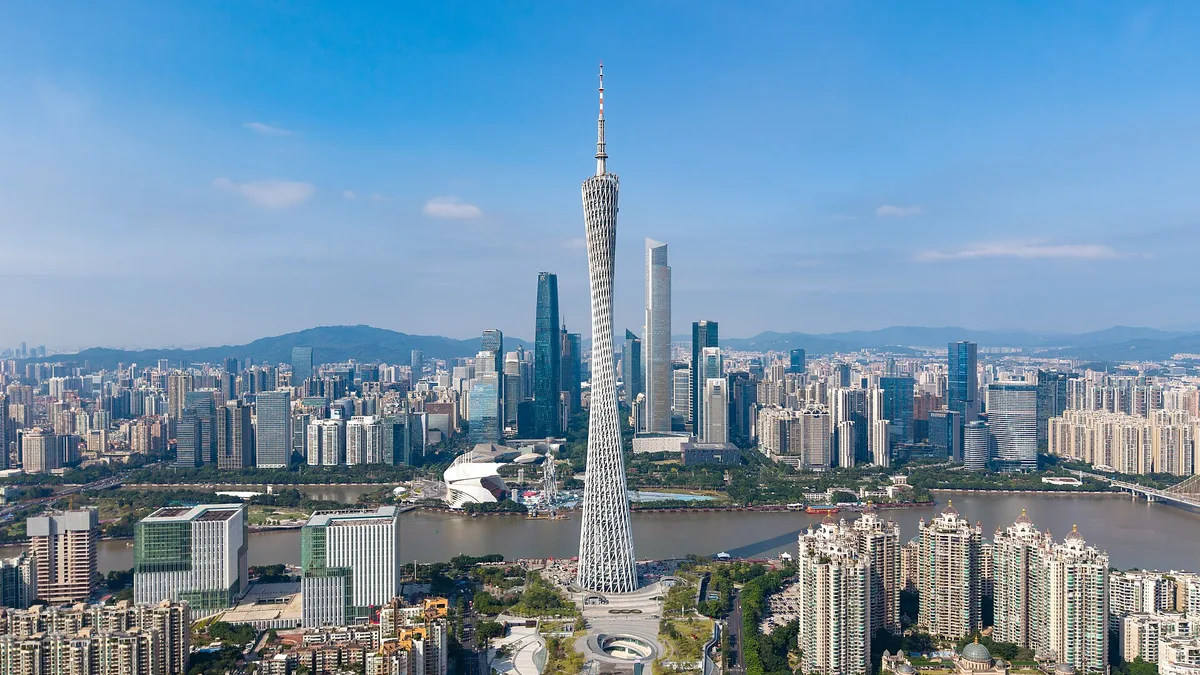
Guangzhou
| Country of origin | China |
|---|---|
| Original use | Sea port for international trade |
| Ships served | Container vessels, bulk carriers |
| Container capacity | Over 20 million twenty-foot equivalent units annually |
| Truck transport time to inland provinces | Varies, depending on destination |
| Major export commodities | Electronics, garments, toys |
| Major import commodities | Machinery, plastics, grains |
Origin and history
Guangzhou is a major port city and provincial capital located in the southern region of Guangdong, China. Its history as a significant maritime trade hub dates back over two millennia, with its port serving as a key terminus of the ancient Maritime Silk Road. The modern port infrastructure, particularly the deep-water facilities at Nansha, began large-scale development and internationalization in the late 20th century. This expansion accelerated following China's economic reforms, positioning Guangzhou to handle the massive export manufacturing output of the Pearl River Delta. The port's administrative entity, Guangzhou Port Group Co., Ltd., was formed through the consolidation of older harbor areas to manage this growth strategically. Today, it stands as one of the world's busiest container ports, a status built upon centuries of trade history and decades of modern infrastructure investment.
What it is for
The Guangzhou trade lane primarily serves as a critical export gateway for manufactured goods from the industrial Pearl River Delta region, often referred to as the "world's factory." It connects southern Chinese production centers to global consumer markets in North America, Europe, Southeast Asia, and beyond. The port complex handles a vast array of containerized cargo, including electronics, appliances, textiles, furniture, and toys. For importers, it is a major entry point for raw materials, commodities, and consumer goods into the southern Chinese market. The lane's function extends beyond simple port calls, encompassing extensive hinterland connections via river, road, and rail to inland manufacturing zones. Its purpose is to provide a high-volume, efficient conduit for international containerized trade, supporting complex global supply chains.
Guangzhou tracking
Tracking shipments moving along the Guangzhou trade lane typically requires using the container number or bill of lading number provided by the shipping line. Most major ocean carriers offer online track-and-trace systems on their websites, which provide the status and location of a specific container. These systems show milestones such as gate-in at the terminal, vessel loading, departure from Guangzhou, transit ports, and final discharge. Third-party logistics platforms and freight forwarders often aggregate tracking data from multiple carriers into a single interface for their customers. For cargo moving through the Port of Guangzhou, the port authority may also provide limited visibility on terminal handling stages. It is crucial to note that tracking granularity and real-time updates can vary significantly between carriers, and inland truck or barge movements may have less visibility than ocean transit.
Guangzhou customer care
Customer care for shipments on the Guangzhou lane is primarily managed by the specific ocean carrier or the freight forwarder/NVOCC that issued the bill of lading. These entities handle inquiries regarding booking amendments, documentation errors, rate confirmations, and release instructions. The Port of Guangzhou authority and terminal operators provide customer service for port-specific issues such as container gate schedules, demurrage and detention charges, and terminal paperwork. Communication is typically conducted via email, phone, or carrier-specific online portals, with service availability following standard business hours in China. Challenges can arise due to time zone differences, language barriers, and the complexity of navigating between the responsibilities of the carrier, terminal, and landside transport providers. For complex issues, having a local agent or a forwarder with a strong presence in Guangzhou is often necessary to resolve problems effectively.
Guangzhou branch locator
Major global ocean carriers and international freight forwarders maintain offices or agency representations in Guangzhou, typically clustered in the city's central business districts like Tianhe or Yuexiu. The port operating entities, such as Guangzhou Port Group, have their headquarters and operational offices located at or near the port terminals, including Huangpu, Xinsha, and Nansha. Nansha, being the primary modern deep-water container port, hosts the main customer service centers for many shipping lines and logistics firms directly within the port area. Finding a specific branch usually involves consulting the "Contact Us" or "Global Network" section of a carrier's or forwarder's official website, which lists address and contact details. For businesses without a dedicated branch, local Chinese logistics partners and agents provide essential ground services and act as a branch extension.
Guangzhou rates
Rates for moving a container from Guangzhou are not fixed and are determined by a volatile market based on supply and demand. These rates, known as freight rates, are set by individual ocean carriers and cover the port-to-port ocean transportation cost from Guangzhou to a destination port. The total cost to move a box includes the base ocean freight plus numerous additional charges, such as the Terminal Handling Charge (THC), Bunker Adjustment Factor (BAF), and Currency Adjustment Factor (CAF). Other common surcharges include peak season surcharges, congestion surcharges, and documentation fees, which can change frequently. Importers and exporters typically obtain all-inclusive quotations from carriers or freight forwarders that bundle these costs, but the final invoice often contains unexpected fees. Rate levels fluctuate significantly based on seasonal demand, global economic conditions, vessel capacity, and fuel prices, making long-term budgeting difficult.
Pros and cons
A primary advantage of the Guangzhou trade lane is its direct access to the immense manufacturing base of the Pearl River Delta, offering shippers a vast selection of suppliers and consolidated cargo volumes. The port infrastructure at Nansha is modern and efficient, capable of handling the largest container vessels, which can translate to competitive transit times and direct service strings. A significant con is the susceptibility to severe congestion, particularly during peak manufacturing and shipping seasons before holidays, which can cause extensive delays at terminals and in hinterland connections. Shippers often regret not accounting for the complex and non-transparent fee structure, where low base freight rates are eroded by a long list of mandatory surcharges, leading to invoice surprises. The common mistake is focusing solely on the quoted ocean freight cost without a detailed understanding of all local charges, demurrage/detention rules, and potential congestion-related costs, which can double the expected expense.
Who it suits
This trade lane best suits large-volume importers and exporters whose supply chains are firmly rooted in the industrial clusters of Guangdong province and who require frequent, direct vessel calls. It is ideal for businesses shipping full container loads (FCL) that can benefit from volume-based contracts and have the resources to manage complex logistics locally. Manufacturers and traders with predictable shipping schedules and strong relationships with forwarders or carriers can navigate the rate volatility and secure better terms. The lane is less suited for small or first-time shippers without local representation, who may struggle with documentation, hidden costs, and problem resolution. It also suits cargo destined for or originating from Southeast Asia and Oceania, for which Guangzhou serves as a major transshipment hub, but may be suboptimal for shipments to certain regions better served by other Chinese ports like Shanghai or Ningbo.