TrinityRail: 200,000 Railcars Nearing Retirement to Pressure
TrinityRail's Charley Moore says 200,000 North American railcars are nearing retirement, creating a supply crunch as lease fleets run at near capacity.
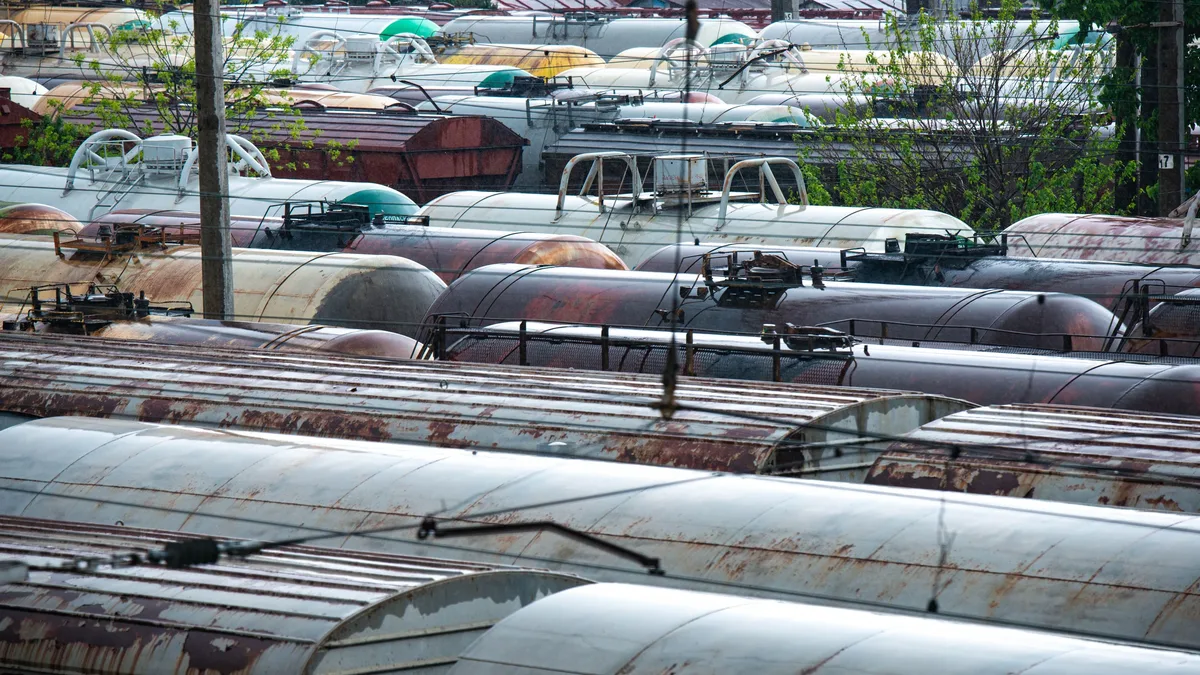
Roughly 200,000 railcars are approaching end-of-life across North America. This creates a major replacement demand cycle in an already tight market, according to Charley Moore, chief commercial officer at TrinityRail.
Moore, speaking on FreightWaves Today alongside Trains magazine editor Bill Stephens, said lease fleet utilization for public lessors is running in the high 90s. This figure highlights the minimal slack in the continent's 1.6 million-car fleet. The looming retirements will pressure this strained system.
Manufacturing Lag and Cost Pressures
The supply crunch coincides with a manufacturing trough. Moore stated the industry expects to build only about, 25,000 railcars in 2026. Higher steel input costs and uncertainty around tariffs have delayed customer capital decisions. He projects production will climb to between 30,000 and 35,000 units in 2027 as structural demand recovers.
Moore noted that elevated new-car prices, driven by these input costs, are simultaneously creating headroom for lease rates. This is a tailwind for Trinity's leasing business. The company is working to offset manufacturing cost pressures through automation, shifting domestic sourcing, and supplier negotiations ahead of the expected 2027 demand upturn.
On tariffs, Moore said uncertainty persists around the application of Section 232 duties to railcars crossing the U.S.-Mexico border. Trinity's position is that its Mexico-produced cars qualify under the USMCA trade agreement. The company is actively engaging U.S. Customs and Border Protection on the issue.
Current Traffic and Volume Drivers
Recent traffic data shows underlying strength. Association of American Railroads figures for Week 34 revealed North American carloads up 1.7% year over year, with intermodal units up 6%. Total traffic rose 3.9%, matching the prior four-week trend. U.S.-only figures were slightly stronger.
| Region | Carloads | Intermodal | Total Traffic |
|---|---|---|---|
| North America | +1.7% | +6.0% | +3.9% |
| United States | +2.2% | +5.7% | +4.1% |
Stripping out coal and grain, U.S. carloads still rose 1.5%. Trains magazine editor Bill Stephens, who also appeared on the panel, said this reflects genuine strength in the underlying industrial economy.
Moore pointed to specific geopolitical disruptions as key volume drivers. Grain disruptions from the Russia-Ukraine conflict have boosted U.S. export shipments. Instability involving Iran has lifted crude oil movements. He also highlighted a resurgence in coal demand, driven by AI-related data center electricity consumption. Stephens corroborated this trend, citing recent announcements where coal-fired power plants in Pennsylvania received life extensions due to rising power demand.
Service Improvements and Merger Impacts
Moore discussed recent service improvements and potential merger impacts. He cited new lanes and better service from various railroads into different markets, including improved service into Mexico.
If you think about post-announcement when UP and NS came out and said, hey, we're going to merge, some things that happened, Moore said. He added that eliminating an interchange in a potential Union Pacific-Norfolk Southern merger could cut transit times by 24 to 48 hours.
Moore acknowledged the Surface Transportation Board would need to address rate concerns for single-railroad captive shippers in any merger. Trinity has publicly stated it is pro-growth, whether through a merger, greater railroad alignment, or improved service. Moore emphasized that any volume shift to rail creates downstream demand for more railcars.
If you move freight by rail, lease equipment or watch intermodal capacity, this is the setup to track into 2027.
The interview was summarized from a transcription provided by FreightWaves.