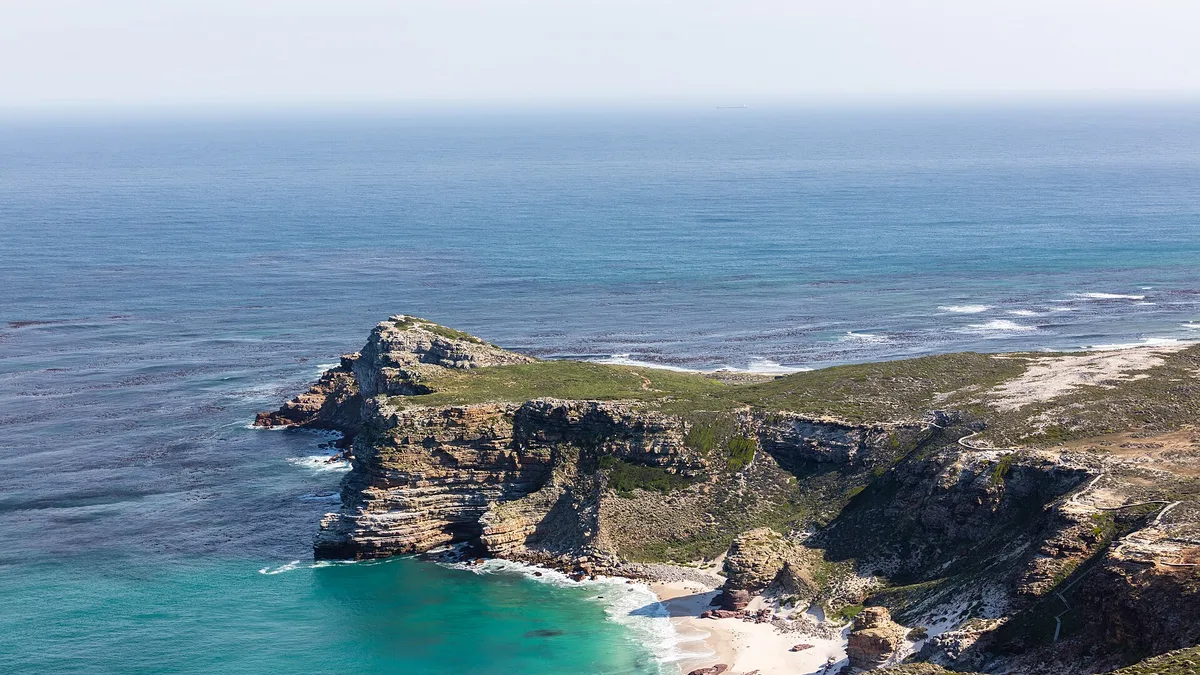
Cape Of Good Hope
| Geographic location | Southern tip of the Cape Peninsula, South Africa |
|---|---|
| Type | Sea route around a continental landmass |
| Controlling nation | South Africa |
| Major ports at route termini | Port of Cape Town, Port of Durban (East), Port of Ngqura (East) |
| Vessels affected | All deep-draft shipping transiting between the Atlantic and Indian Oceans |
| Primary alternate route | Suez Canal |
| Original use | Historic sailing route between Europe and the East |
Origin and history
The Cape of Good Hope is a rocky headland on the Atlantic coast of the Cape Peninsula in South Africa. It was not "created" but is a natural geographic formation that has existed for millennia. Its documented history begins with European exploration in the late 15th century. Portuguese explorer Bartolomeu Dias first rounded the cape in 1488, naming it the "Cape of Storms." It was later renamed the "Cape of Good Hope" by King John II of Portugal to reflect the promising maritime route it offered to the Indies. For centuries, it served as the primary maritime chokepoint for voyages between Europe and Asia before the opening of the Suez Canal. Its strategic significance as a maritime passage is therefore rooted in both its natural permanence and its late 15th-century discovery by European navigators.
What it is for
The Cape of Good Hope functions as a critical global maritime chokepoint for commercial shipping traffic. Its primary purpose is to provide a navigable sea route connecting the Atlantic and Indian Oceans. It is a mandatory passage for vessels that are too large for the Suez Canal or are traveling between Asia and the Americas' eastern seaboard. The cape serves as a key lane for the transport of bulk commodities, including crude oil and minerals, as well as containerized goods. It also remains a vital alternative route when geopolitical tensions or operational issues close the Suez Canal to traffic. Consequently, it acts as a stabilizer for global trade routes, offering a longer but dependable sea passage for international maritime commerce.
Pros and cons
A primary advantage of routing via the Cape of Good Hope is its reliability as an open ocean passage free from the canal fees and transit delays associated with man-made waterways. It avoids the political volatility and security risks inherent in narrow chokepoints like the Bab el-Mandeb or the Strait of Hormuz. The significant con is the substantial additional sailing time, which can add over two weeks to a voyage between Asia and Europe compared to the Suez route. This dramatically increases fuel consumption, crew costs, and inventory carrying costs for shippers. Vessels also face the unpredictable and often severe weather conditions of the Southern Ocean, known for powerful storms and large waves that can pose safety risks. A common mistake is for shipping lines to view it only as a contingency plan without properly modeling the total impact of extended transit times on their supply chain resilience and cost structures.
Who it suits
The Cape of Good Hope route suits ultra-large container vessels and Very Large Crude Carriers (VLCCs) that physically cannot transit the Suez Canal due to draught or beam restrictions. It is also a necessary route for cargo journeys originating in Asia with final destinations on the east coast of South America or southern Africa. Shipping lines carrying low-value, high-volume bulk commodities like iron ore or coal, where transit time is less critical than cost, may also regularly utilize this route. Furthermore, it suits any operator during periods when the Suez Canal is inaccessible due to groundings, political closures, or security threats, as it provides a guaranteed, if slower, alternative. Finally, it can suit companies seeking to avoid Suez Canal tolls for whom the additional fuel cost of the longer journey is calculated to be lower than the canal transit fee.