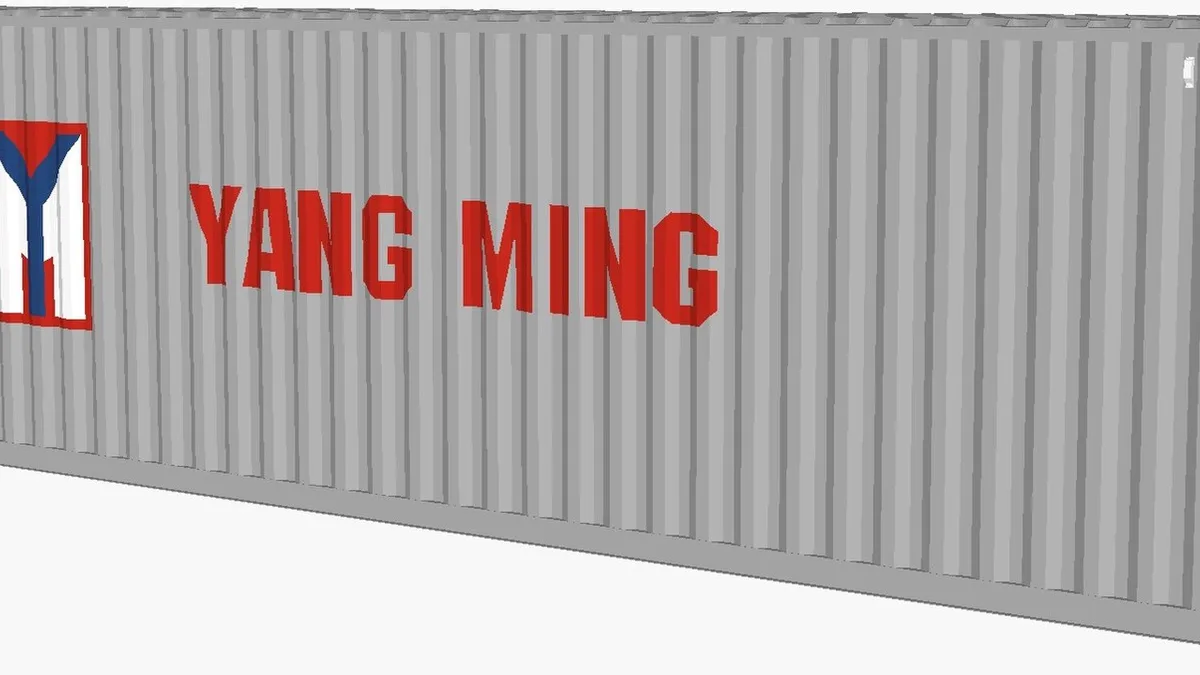
Yang Ming
| Company type | Publicly listed shipping company |
|---|---|
| Headquarters location | Taipei, Taiwan |
| Fleet size | Over 90 container vessels |
| Primary trade lanes | Trans-Pacific and Asia-Europe |
| Service network | Operates within THE Alliance consortium |
| Container capacity range | From feeder-size to ultra-large container vessels over 24,000 TEU |
| Original use | International container shipping and logistics |
Origin and history
Yang Ming Marine Transport Corporation is a container shipping line originating from Taiwan. The company was established in the early 1970s, a period of rapid industrialization and export growth in the region. Its founding was part of a broader national strategy to develop a self-sufficient maritime infrastructure. Initially, the company operated a small fleet of conventional vessels before transitioning into the container shipping industry. Over the decades, it has grown from a regional carrier into a global operator. Its history reflects the post-war economic transformation of Taiwan into a major hub for international trade and manufacturing.
What it is designed for
Yang Ming is designed as a global container shipping carrier, transporting standardized freight containers via sea on scheduled routes. Its core purpose is to provide ocean freight services connecting major ports worldwide, facilitating the movement of manufactured goods, raw materials, and consumer products. The network is engineered to integrate with land-based transportation, such as trucks and trains, for door-to-door logistics solutions. The service is fundamentally built for commercial shippers, including manufacturers, retailers, and freight forwarders, who require reliable, scheduled transport for their cargo. It is designed to operate within international shipping alliances, sharing vessel space and port calls with other carriers to optimize network coverage and efficiency. The design prioritizes the efficient utilization of vessel capacity and the optimization of route density between key trade hubs.
Development and versions
The company's development has been marked by a steady expansion of its fleet and service routes, progressing from regional Asian services to a full global coverage. A significant phase in its development was the strategic ordering of increasingly larger container vessels to achieve economies of scale, including a series of modern 14,000 TEU ships. Its operational model has evolved through membership in various global shipping alliances, which define its service loops and port rotations. There are no distinct "versions" of the carrier in a consumer sense; development is reflected in fleet modernization, terminal investments, and digital service offerings. Key milestones include the expansion into trans-Pacific and Asia-Europe trade lanes, cementing its status as a global player. The development path continues to focus on fleet renewal for environmental compliance and the integration of digital tools for supply chain visibility.
Pros and cons
A primary advantage of Yang Ming is its strong network coverage across major East-West trade lanes, particularly from its strategic position in North Asia, offering shippers a reliable alternative within alliance structures. The carrier is generally considered competitively priced within the market, though specific rates fluctuate with supply and demand. A notable con is that, as a mid-sized global carrier within a large alliance, its direct service frequency on specific port pairs can sometimes be less robust than that of the very largest carriers, potentially leading to longer transit times or less schedule flexibility. Some shippers report that customer service and communication during operational disruptions can be inconsistent, a common industry challenge but one that varies by regional office. A common mistake for users is booking without verifying the specific vessel-sharing agreement and actual operating carrier, which can lead to confusion regarding liability and service contact points. Shippers who prioritize absolute schedule reliability on niche routes or require extensive dedicated customer support sometimes regret the choice when severe market congestion strains the carrier's resources.
Who it suits
Yang Ming suits shippers with cargo volumes moving on major trade routes, such as Asia to North America or Asia to Europe, where its alliance participation provides ample coverage. It is a practical fit for cost-conscious BCOs (Beneficial Cargo Owners) and freight forwarders who seek a balance of rate and service on core lanes. The carrier is well-suited to businesses exporting from or importing to Taiwan and key mainland Chinese ports, where it maintains strong terminal presence and operational expertise. It suits shippers whose supply chains are flexible enough to accommodate potential schedule adjustments inherent in alliance service loops. It is less suited for shipments requiring highly specialized equipment or services outside standard dry container needs, as its fleet focus is on mainstream cargo types. Finally, it suits logistics managers who are comfortable navigating the complexities of alliance-based shipping and who have alternative carrier options for mission-critical, time-sensitive shipments.